
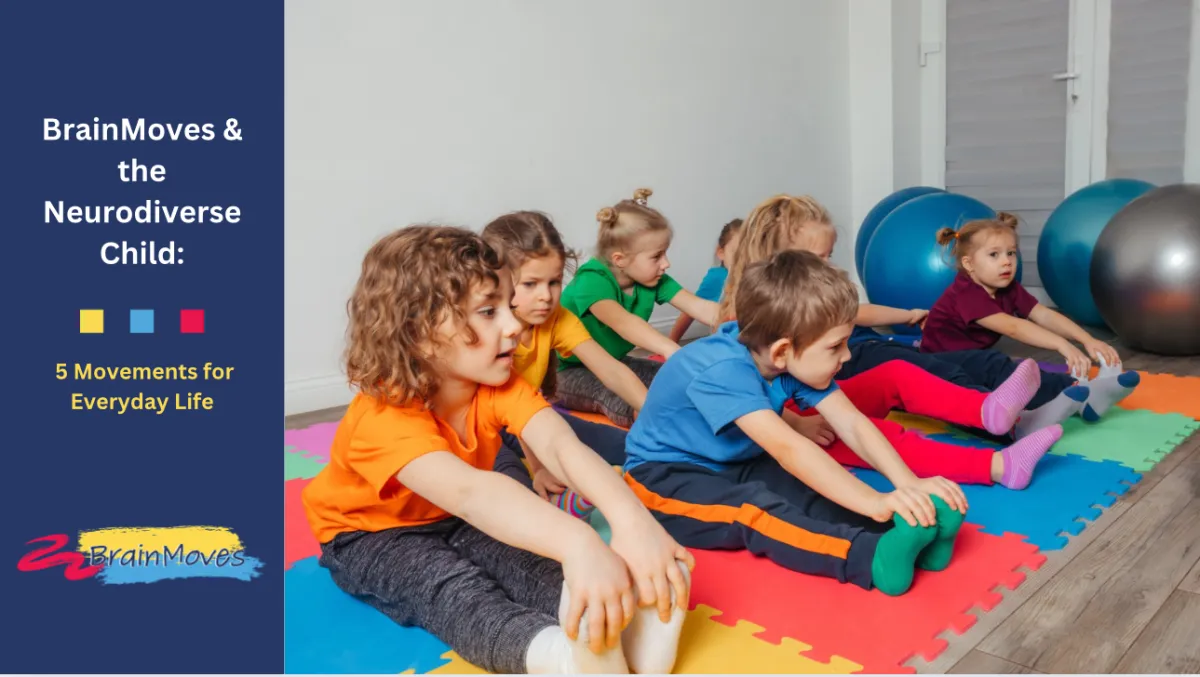
BrainMoves and the Neurodiverse Child: 5 Movements for Everyday Life
In our periodic series about how to use BrainMoves in real life, I’d like to share an example. Over the next few months, I’ve decided to give examples of how I think about using BrainMoves to help different types of students and learners.
As you may recall from earlier classes and posts, I work with a variety of different populations. With my elementary-aged students, I often see individuals with unidentified learning differences and/or behavioral challenges. Often, they’re in my afterschool program because they have concerned or engaged parents who want to make sure that they’re providing the best for their child, no matter how their brains are wired. They understand that enrichment programs like STEM, afterschool cooking, or physical activity will help their child integrate what they have learned and be calmer. This is true because it’s based upon the same principle that BrainMoves movements are based upon: Movement and engagement are what our bodies are designed to do.
Many children in my after-school classes are neurodiverse and wired to process information differently. Sometimes that comes with its own emotional baggage, even at six, seven, or eight years old. BrainMoves movements can help these children process and enjoy the after-school activities much more easily
One child was recently brought to me by a teacher who said, “You have—let’s call him Jeremy—in this

class. You let me know if you have any problems with him.” I understood immediately. Jeremy was considered a “problem child.”
I looked down at little Jeremy and saw what many would see as a perfectly ordinary seven-year-old. Very quickly, I saw that little Jeremy was a bundle of energy. He never stopped moving. He was like a wind-up toy who left his house at seven and stayed in perpetual motion until he collapsed in utter exhaustion—usually 20 minutes before being dismissed from the afterschool program.
Along the way, he would misunderstand, bump into things, drop things, and even explode things just to see what would happen—all while using his voice very loudly. Other students became louder in Jeremy’s presence, even though Jeremy didn’t want to play with them. It was as if he were a megaphone amplifying all their loud sounds, simply because he was pointed in their direction.
I knew that Jeremy’s brain was wired differently. He was usually stuck in the “freeze, fight or flight” survival center of his brain, and thus he was always looking for something to keep himself busy and moving fast. Moving fast helps children like Jeremy manage the stress that comes with being stuck in freeze, fight or fight mode. Keeping himself busy didn’t always mean that he was available to listen and learn. It was a coping mechanism that kept him from feeling anxious, but even as a seven-year-old, he had already learned that adults didn’t like this coping mechanism and was beginning to carry guilt or resentment for being told that he couldn’t do things.
One day after class he came running up to me and said, “I’ve learned that a second takes longer than I thought it did. It goes like—” and he demonstrated with his hands, “Tick, tick,” not like—” and then he moved his hands at twice the speed. I paused, looked him in the eyes, and said, “You are absolutely right, Jeremy. That is exactly how long a second takes. Sometimes you can hear the sound of a clock ticking in your head if you want to count a second.” He paused and processed this, then said, “I was told that regular walking takes longer than one second for each footstep. It’s more like this—” and the seven-year-old proceeded to moonwalk.
With this interaction Jeremy showed me that he was capable of learning and insight. This child didn’t have difficulty concentrating on the things in which he was interested; however, when he was hyperactive, the challenge was to help him get to a place where he could absorb information.

I started working with Jeremy using BrainMoves for just five minutes a day. We did the following movements. I first selected a movement that would help him calm down and be aware of his body. This helped him to be more coordinated so he didn’t hurt himself or others. This is a safety issue and also an embarrassment issue. When he knocked over his pens or his toothbrush every single morning, he felt bad because he thinks he is clumsy. He was already showing some signs of feeling different or having been made to feel guilty by his surroundings. There’s no need to encourage that by having him self-report as guilty or clumsy.
The movement I used to help him calm down and be more coordinated was the Bear Cub. This movement helps us move out of “freeze, fight or flight” mode (one of the sources of Jeremy’s hyperactivity) and brings our awareness back to the core or center of our bodies.
Another thing that I thought would help Jeremy was to have the ability to pause and take a deep breath, because the faster he moved and the faster he tried to speak, the less time he had to breathe, and the more anxious he became. The movement I used to help him with this was the Blowfish. The Blowfish helps us breathe slowly and deeply, while lengthening the muscles around the mouth and tongue that are contracted.

To help Jeremy process sounds, I taught him how to do the Koala Cub movement. This one is also helpful because, even though Jeremy is sometimes the cause of everyone else shouting in the room, that shouting is overstimulating and can cause his brain to shut down. The Koala Cub movement has the advantage of helping him regulate those sounds, and helps him to hear better, regulate the volume of his voice and speak more quietly—keeping the other children from getting louder, too.
When he’s doing an assignment, especially if it is looking at and learning new information, we know his brain might be stuck in freeze, fight or flight mode. When this reflex is “stuck on” Jeremy will be susceptible to outside distractions and the almost impossible need to move his body quickly. His brain is ultimately capable of handling a lot of information, but not until he learns to manage this distractibility and the need to move randomly. To help him with this, we did three eye-tracking movements. We started with the easiest one - the Blue Crab, and then moved on to the Red Crab, which requires crossing the midline at midline and then to the Green Crab which requires crossing the midline using the entire visual field.
I also taught Jeremy to do the StartUp Six on his own when he felt he needed help. The StartUp Six helps with hearing and listening, focus and concentration, organization, using the frontal lobes of the brain, gross motor skills, relaxing the freeze, fight or flight reflex and staying calm.
I’m sure that classroom instructors, teachers, and parents reading this may have a little Jeremy in their house or class right now. What BrainMoves would help your child better learn and calmly participate in school, home and social events? If you have a little Jeremy in your classroom at the moment, or Jeremy sounds just like your child, you’re not alone. Every child can benefit from BrainMoves to help them focus, feel calmer, and generally be their best.
If you want to help your child learn, grow, and be more comfortable in social settings and at school, sign up for the self-paced BrainMoves course today. It’s easy. It’s simple, and it takes just five minutes a day to learn. Just a few moments of movement a day can help your child be happier and healthier.