
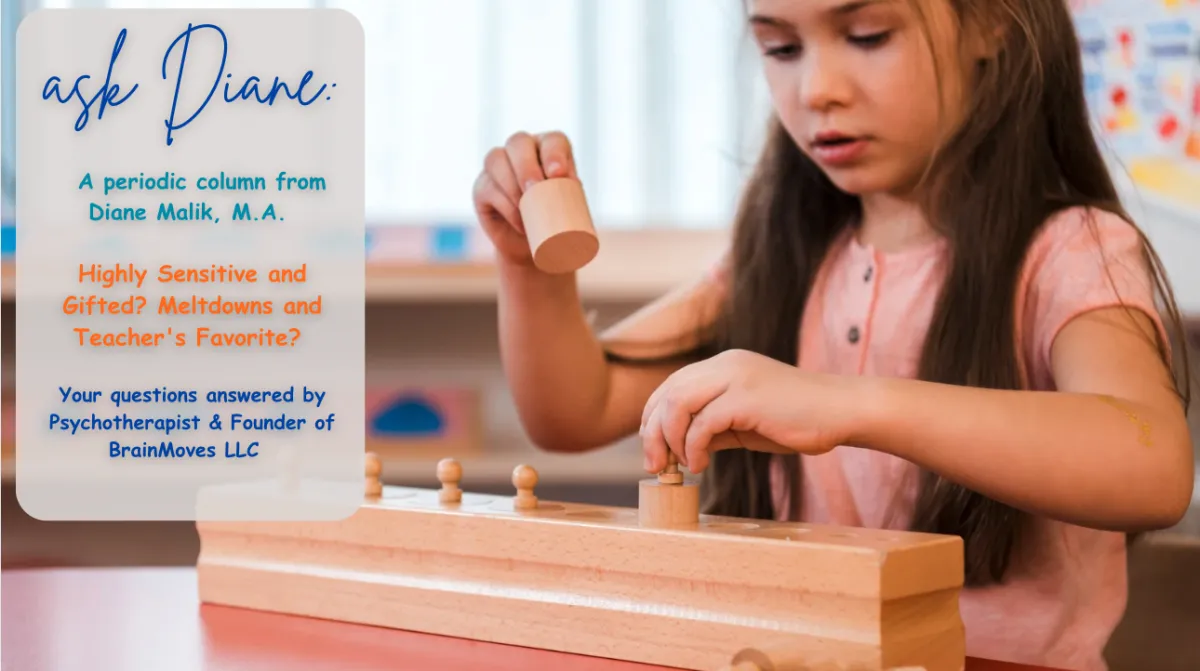
Highly Sensitive and Gifted? Meltdowns and Teacher's Favorite?
Dear Diane,
I have never emailed into an advice column before, but after reading your blogs for the past year, I thought you might be the best person to ask this question, as it’s a bit odd. My daughter has me so stressed out. I am questioning if I am still a good parent. She is both the “best” and the “worst” in the class in terms of her behavior and I don’t understand why!
I’m the mother of three children: A 22-year-old boy and two preschool-aged twin girls. The twin girls were not planned, but my husband and I are delighted to have the opportunity to have girls, and twins at that. Maya and Maria are both amazing and delightful—they’re bright, curious, and completely charming. However, I feel they are significantly harder to parent than my son.
My son, George, was like any other preschooler. George would have days when he was delighted to go to school and days when he wasn’t, but he would generally hop out of the car and race to the playground to play with his friends. I often had to chase after him to bring him his coat and his snack. He was outgoing, social, and engaged.

The girls, however, seem to fluctuate wildly. In particular, Maya will sometimes love going to school and will start talking about things that are going to happen days in advance with anticipation. It’ll be all we hear about at home—if they’re going to draw cats tomorrow or if there’s going to be a bunny in the classroom for spring, we’ll get all the details. Other times, she will have a meltdown and become completely unable to leave the car or even consider going into the school that morning. Her twin will be standing on the sidewalk, waiting, and I’ll have to hold up the entire parent-car line while I work to get Maya out of the car.
Her preschool teachers report the same thing. Sometimes she’s incredibly engaged, and they have even suggested that she could be gifted. On the other hand, there are times when she simply cannot sit still or focus.
I want to do the best for both twins, and they will be tested for the gifted program late next month. But what if Maya is having an “off” day when they do the assessment? I don’t want to jeopardize her chances of an even better education through the gifted program because of the meltdowns and disorderly behavior her teachers are starting to report.
Help—what do I do?
Signed, “Worried “in Washington.
Happy New Year, “Worried”.
It sounds like you do have some very special twins, even though they are very different from each other. Just because they’re twins doesn’t mean they’re going to share the same response to stress.
Stress? Yes, I think that is perhaps part of the origin of Maya’s behavior. Many parents are surprised to find out that preschoolers and kindergartners can experience stress. We tend to think of this as something that happens to people in high-pressure workplaces or to older students preparing for exams or college. In actuality, stress is a physical and mental condition that causes the brain to go into the “freeze, fight or flight” survival center of the brain. This makes the brain and the body struggle to cope. Stressors for a preschooler can range from not having the type of food they want for a snack to being bullied or unable to read the chalkboard. Stress is when the emotional or physical demand exceeds capacity.

Based on the information you’ve shared, Maya is a very sensitive child in addition to being potentially gifted. That’s not uncommon. It’s common to see young children who meet the qualifications for the gifted program also be very aware of their surroundings and the small details of the people and places they visit. If a child is highly sensitive, even regular events can be very stimulating for them.
I wouldn’t be surprised if some days Maya’s excitement about school exhausts her, and when she discovers the next day that she has to go back to school, she literally doesn’t have the energy for it—thus, you have a meltdown. Her supply of energy to process the new data from a school day doesn't meet demand.
Additionally, while Maya may love school and learning, if she’s overstimulated, she may find that there are times when she understands the teacher well and other times when the day is very confusing for her. When Maya is overstimulated, the teacher isn’t getting a lot of her attention because Maya is busy thinking about other details. Again, this is a very common, highly sensitive, and gifted child situation. Your gifted program has probably already seen many students like this and this may even be something that they are prepared to help you navigate. Perhaps ask other parents whose children are already in the gifted program at your school or ask for information about the program to prepare yourself for the assessment process at least.
Having said that, there are many BrainMoves movements that can help your child process information, both visually and auditorily, and can help a child sort that information. These can help children of all ages who are highly sensitive. I like to start by looking at how your daughter responds when she’s overstimulated. You say she constantly speaks about topics she’s interested in. She is highly verbal. This means she’s probably receiving and processing a lot of information auditorily.
You can confirm this by paying attention to the things she is excited about. Is she telling you about things she hears or things she sees? If she’s overwhelmingly talking about the bright colors in the room, the shiny things that are happening, or noticing elements in your space that are visual, you can assume that her eyesight is working overtime and that her visual processing centers in her brain are taking in as much information as possible.
There’s a good chance that that is where the overstimulation is coming from. If, on the other hand, she responds by telling you about all the things people said, sounds that she heard, the birds chirping in the playground, the sound the basketball makes on the court, how squeaky her sneakers are, we can assume she’s receiving an extra dose of auditory stimulation. If she’s just talking about everything, we can assume she is absorbing all the information around her like a sponge.

Any of these is possible, but they can help us guide which BrainMoves movements to start with. I would recommend that we start with the StartUp Six. The goal of these movements is to establish a baseline of calm and security. The StartUp Six consist of the Koala Cub, which helps with processing what she hears and decreasing sensitivity, the Duckling, which releases the freeze, fight or flight response from head to toes and improves focus, the Monkey, which improves gross motors skills and lays the neural foundations needed for fine motor skills, the Parrot, which helps with emotional stabilization and organization and organization activities in general, the Kangaroo, which also helps with stabilization and organization and helps calm us down. It also help bring more oxygen into the brain, which helps us to think more clearly. The last movement is the Bear Cub, which helps to relax the freeze, fight or flight reflex in the brain and restore centering and proper circulation throughout the body.
The next thing to look at is the Raccoon to help with vision.
When she gets home from school, and she has 400 things racing through her mind, you can repeat the StartUp Six movements or ask her to do the Bear Cub for a minute or two.
None of these movements are complicated, and you can learn them all in the online BrainMoves course videos. The videos also include measuring activities to help you see where your child is starting and notice the improvement after she has done the movement. They’re easy, they’re fun, and the children love the animals and animal stories.

Lastly, I would recommend that when you start to think about the assessment, if you notice that you feel stressed yourself, consider doing some BrainMoves movements for calmness and relaxation. Adults can use these movements as well.
I’d recommend that both Maya and Maria do just five minutes of BrainMoves with the StartUp Six before and, if they need it, after school, and then spend a little bit of playtime with you. It will help them feel calmer and more focused. If that works well, you can show these movements to the preschool teacher. Preschoolers love BrainMoves because they feel good, and they have fun animals associated with each movement. Preschool teachers love BrainMoves because it helps children be happier and more focused, making their job of helping them learn and grow that much easier.
Hope this has been helpful for you; try 5-10 minutes of movement twice a day and let me know what results you see.
Best, Diane